
~150ms
Optimistic ACK
Roughly 0.15s to optimistic completion gives DeFi a more immediate, CEX-like trading feel.
CEX Experience · DEX Trust
SSS DeFi delivers a CEX-grade UI, speed, and privacy-aware experience while keeping both frontend and backend on-chain on ICP. It also makes trust boundaries, result verification, exit paths, and risk controls clearer and easier to inspect — so trading feels faster, clearer, and easier to trust.
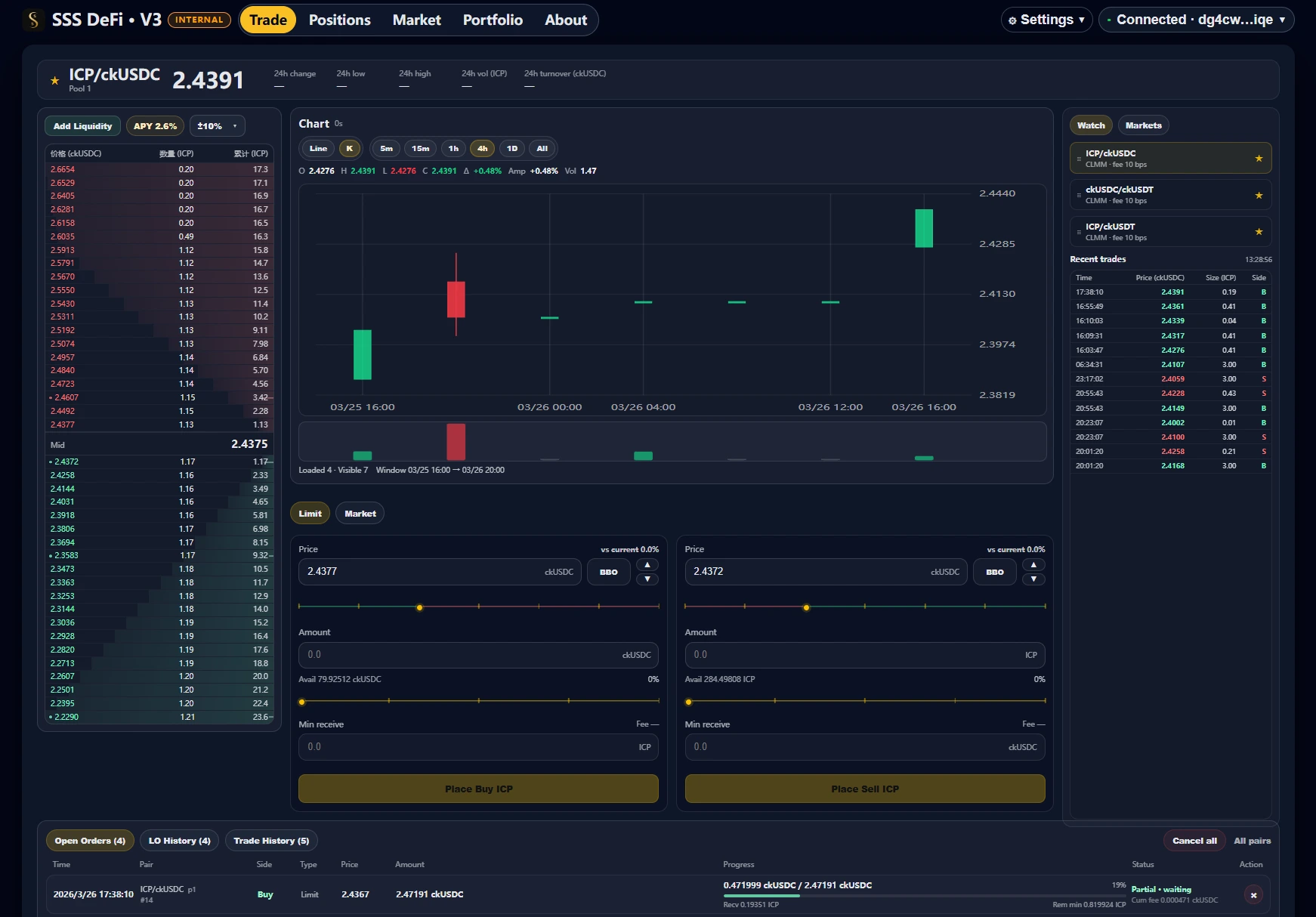
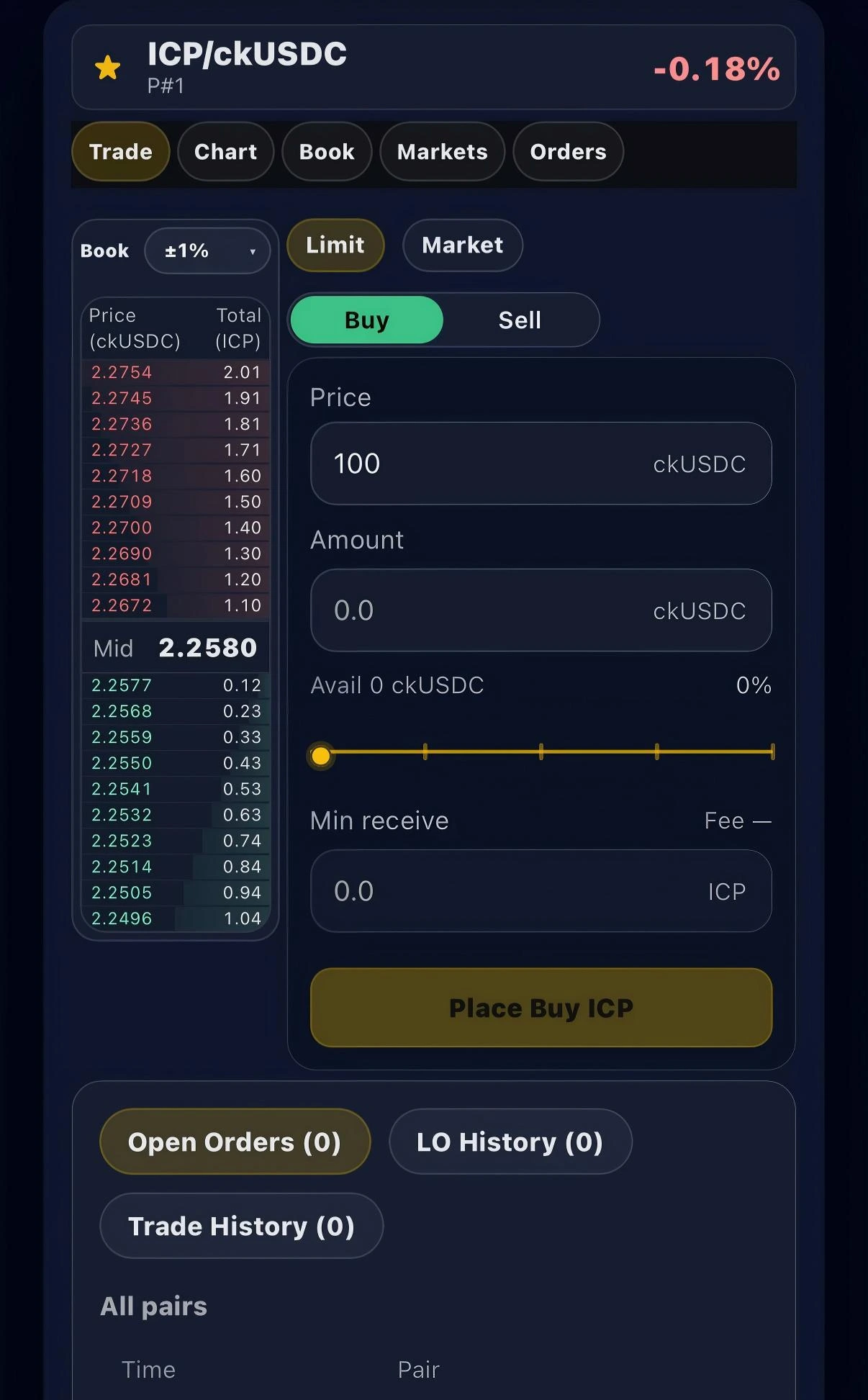
4 quantified indicators that make SSS performance and safety easy to understand at a glance.
Roughly 0.15s to optimistic completion gives DeFi a more immediate, CEX-like trading feel.
Roughly 2.6 seconds to on-chain finality delivers one of the leading settlement speeds in DeFi, with on-chain safety verification that CEXs do not provide.
Zero user-side gas materially lowers trading costs and helps deliver a CEX-like trading experience that most DeFi products still do not offer.
Unlike most DeFi products that still rely on Web2 cloud servers for the frontend, SSS runs both frontend and backend on ICP mainnet, making long-term operation safer, steadier, and more reliable.
4 core product capabilities that form the foundation of the SSS trading system.
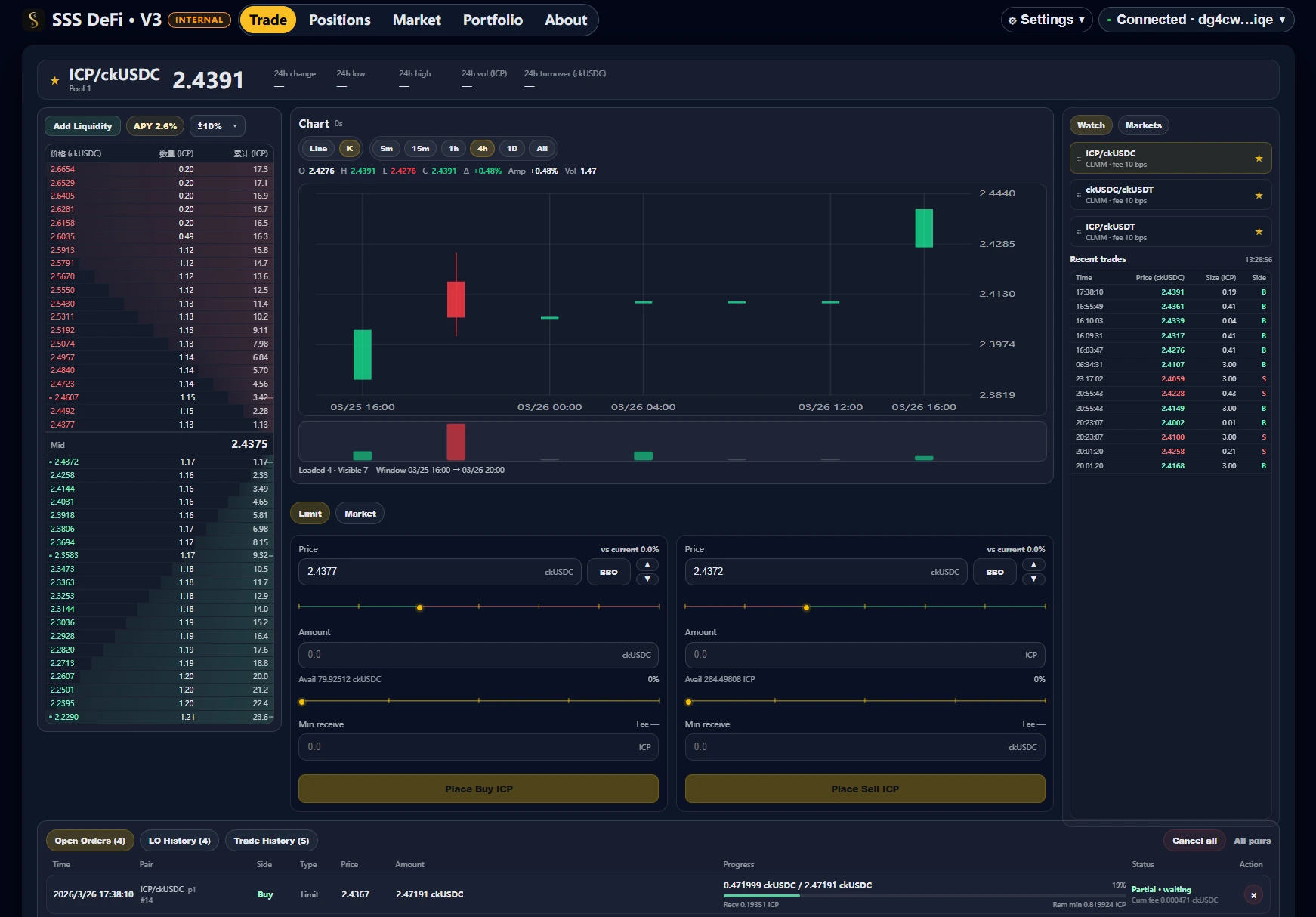
The trading surface includes a fuller DeFi orderbook context and supports limit orders and partial fills, instead of stopping at a traditional single-swap page.
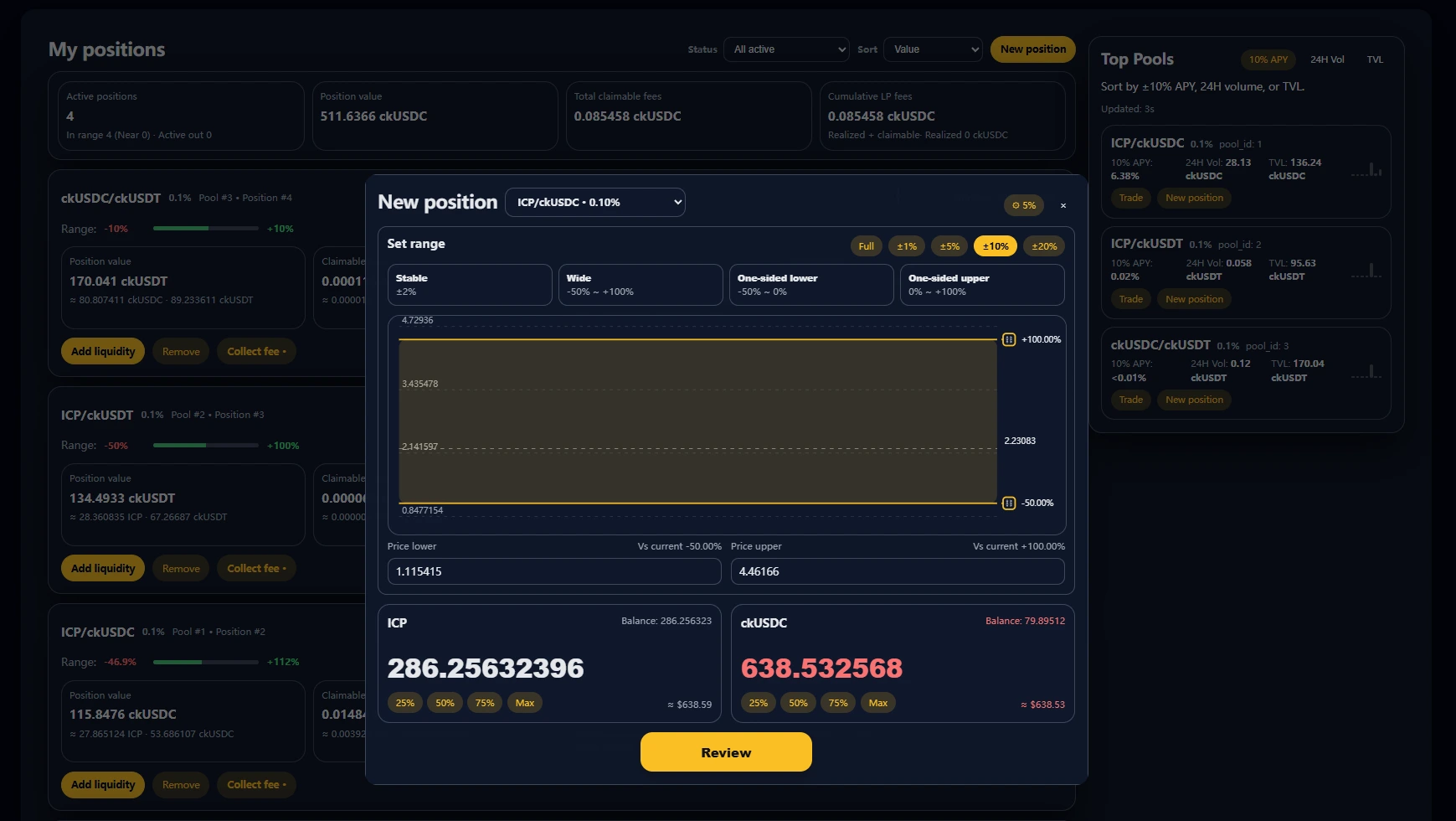
Liquidity is presented through a more visual and integrated CLMM flow, making range decisions easier to understand and operations easier to execute. It lowers the market-making threshold versus CEXs while remaining more structured than traditional DeFi.
Unified balances and one internal ledger bring the whole product path closer to a CEX-like flow, with future support for multi-chain native assets such as BTC, ETH, and SOL.
Clear on-chain audit boundaries and privacy-aware trading protection aim to combine DEX-grade asset safety with CEX-grade intent protection, with stronger institutional auditability and privacy support planned over time.
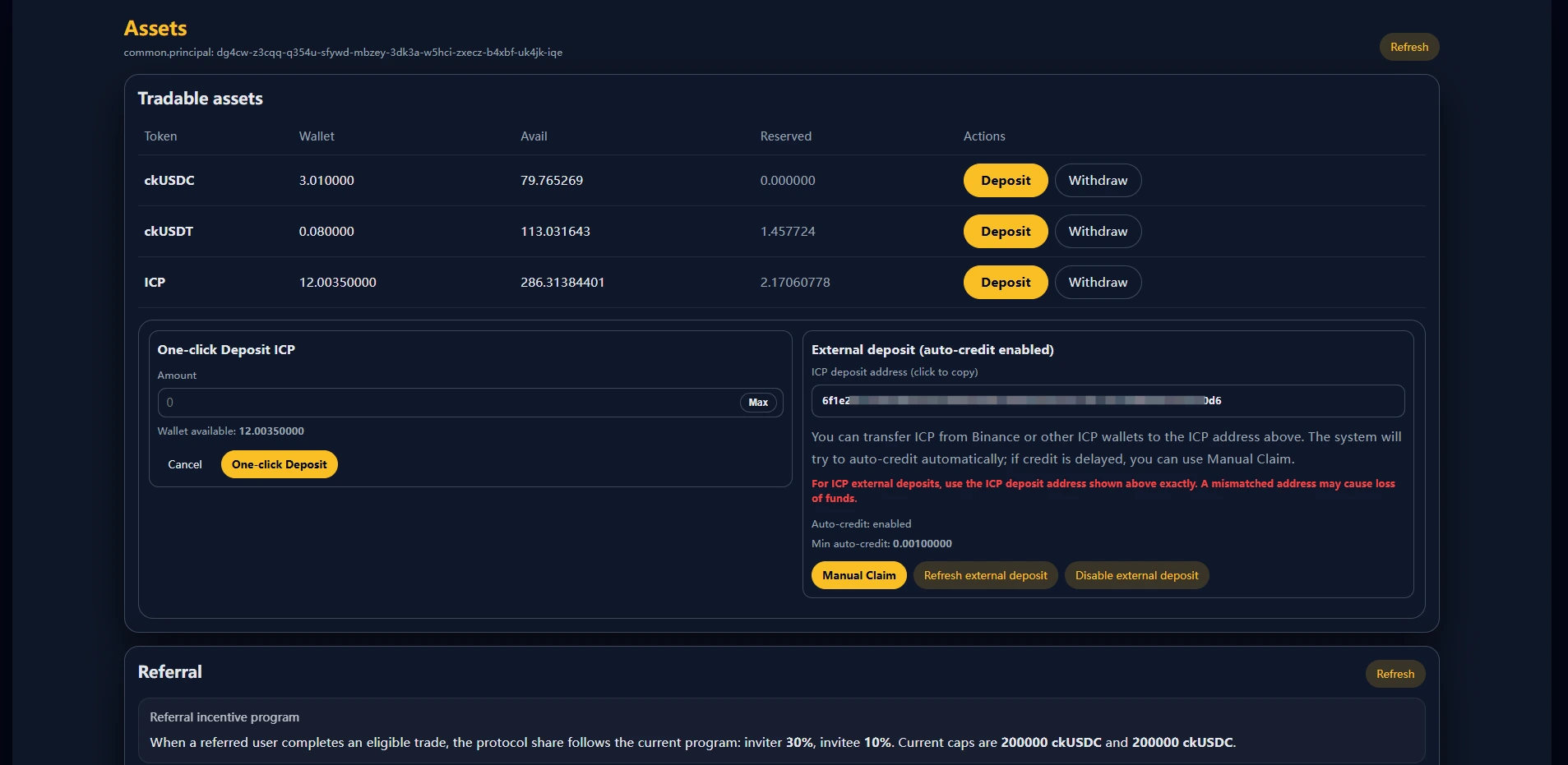
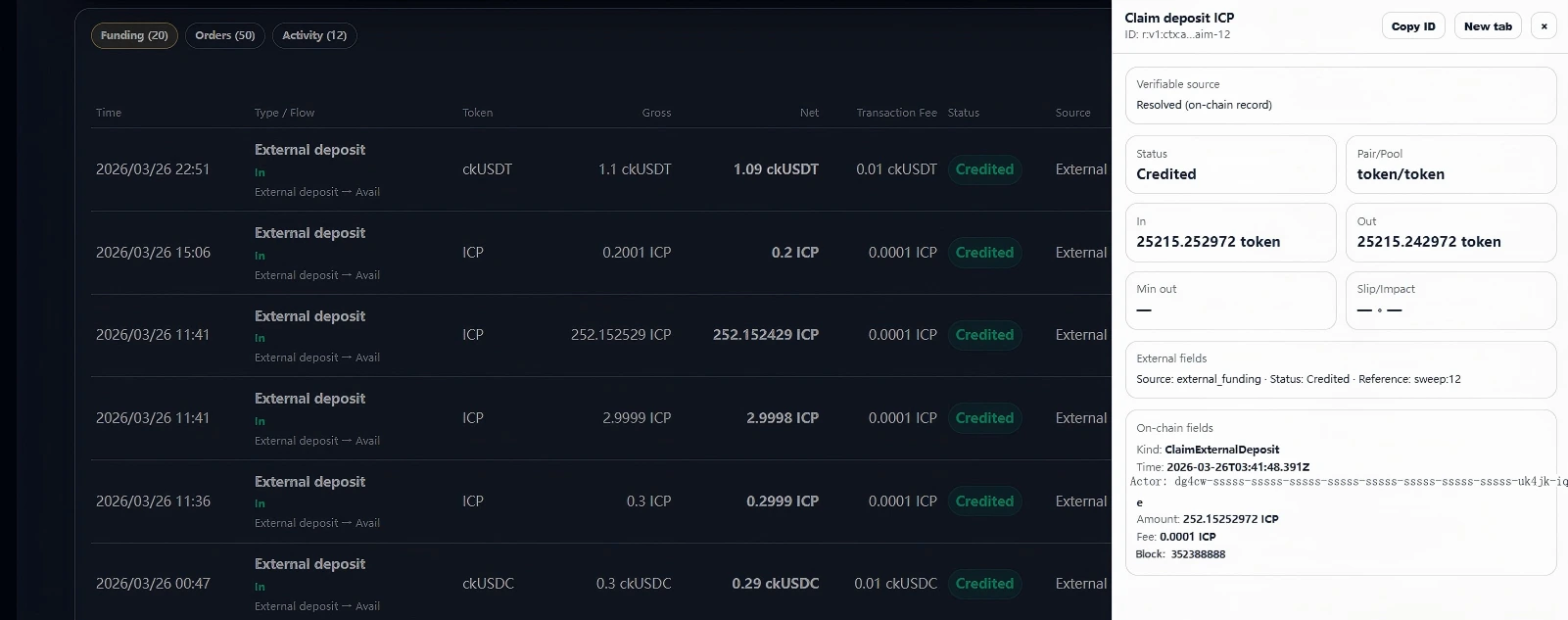
Assets brings balances, funding, withdrawals, orders, activity, and receipts closer to one account surface, so the system starts to feel coherent before users even place a trade.
The trading surface is built around orderbook context, limit workflows, and partial fills, so execution feels closer to a real trading flow than a one-shot swap-first interface.
The pool surface makes positions, ranges, and liquidity behavior easier to read visually, so users can understand and manage CLMM exposure through a more structured interface.
Receipts, activity, and linked records give users a clearer path to inspect what happened after execution and to reason about final state instead of trusting a black box.
The capability breakdown below shows how SSS design principles, product experience, and long-term goals fit tightly together.
The goal is to make UI, speed, and privacy feel like one coherent trading system rather than the fragmented experience common in traditional DEX products.
Get immediate feedback first, then follow through to on-chain finality.
Market, limit, and liquidity workflows live in one trading surface.
Express trades with more precision than one-shot swapping.
See liquidity, price ranges, and position logic in a form users can actually understand.
Trade from one account surface instead of stitching together wallets, approvals, and pages.
A trading path that stays legible and actionable on smaller screens.
Start from ICP-native assets and make the core funding, trading, and settlement path deeper and smoother first.
Continue expanding more mainstream asset rails while keeping one consistent trading experience.
Keep improving execution efficiency and operator flow for higher-frequency and more complex trading scenarios.
The goal is to keep outcomes and asset flows readable and verifiable on-chain, without leaning on CEX-style black boxes, centralized discretion, or third-party bridge assumptions.
What happened is inspectable, not hidden behind a platform-only status.
Follow an action through receipts, activity, and settlement records.
Final outcomes are anchored on-chain and can be independently checked.
Users can understand what the system does, what the chain finalizes, and where responsibility sits.
Execution is designed to be verifiable without asking users to trust a custodial black box.
From submit to ACK to finality, the path is clearer and more deterministic.
Avoid traditional third-party bridges so paths stay shorter, clearer, and safer end to end.
Strengthen privacy and auditability further while keeping outcomes verifiable.
Move gradually toward a more transparent and sustainable decentralized governance structure.
SSS moves in three stages: prove the stablecoin system first, complete multi-asset validation next, and only then scale into platform distribution, tooling, and governance expansion.
The stablecoin core loop is already live and validated on ICP.
Current position: midway through Phase 2. The system foundation is already in place; the work now is to extend it to broader assets, tougher conditions, and public-test scale.
This is the platform stage: once the multi-asset system is proven, SSS scales through integrations, tooling, privacy, and governance expansion.
Read the current public-test boundary: what is verifiable now, who controls what now, and how exits are framed today.
Read the fuller product narrative after you already understand the homepage and the current boundary.
Open the investor-facing view for positioning, metrics, and dataroom-style material.
Track public updates and product notes without turning the homepage into a documentation wall.
Use X and OpenChat for public-test support, feedback loops, and product updates.